Journal
heli
Everest Helicopter Tour: Experience Mount Everest from the Sky
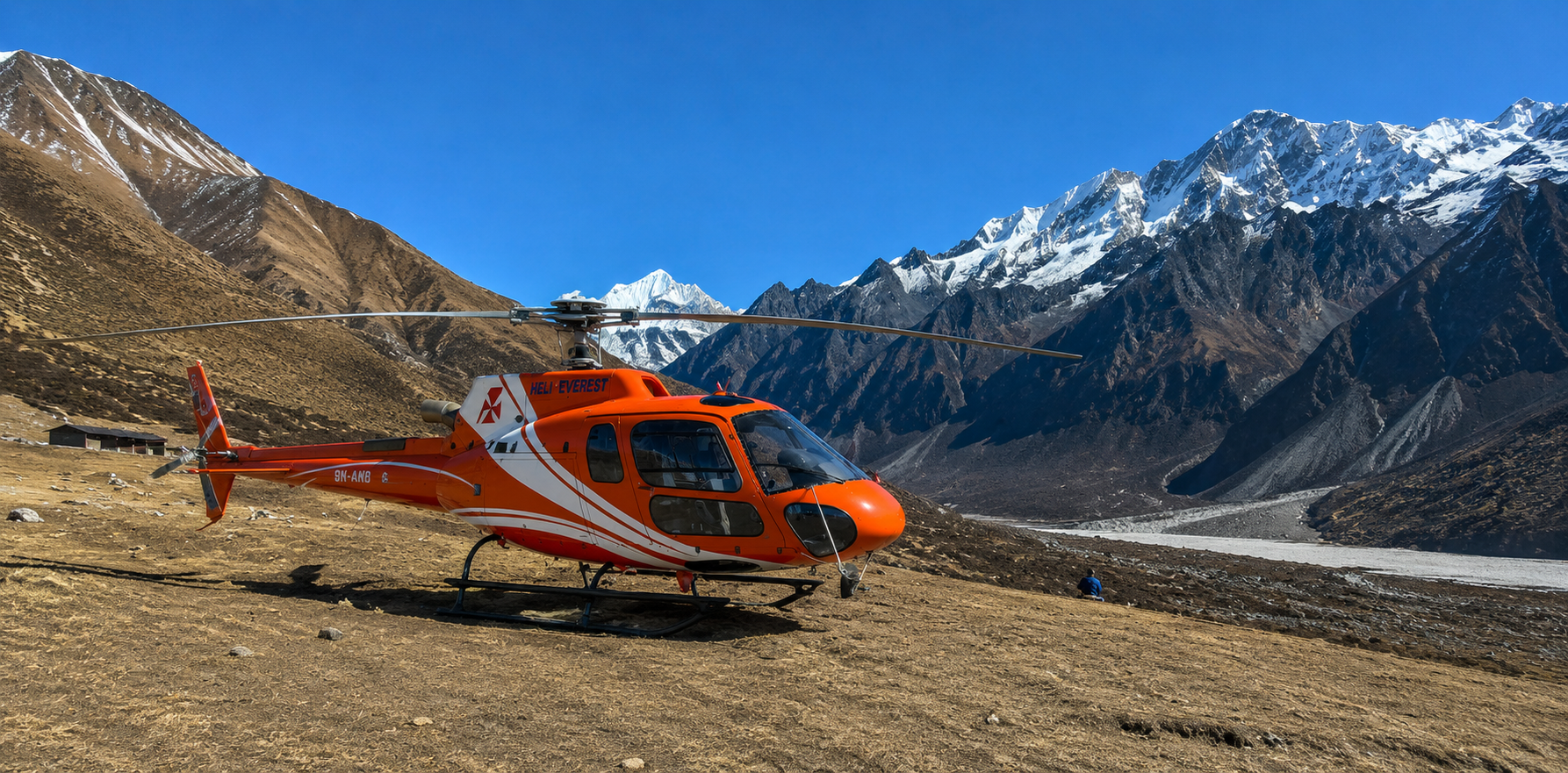
An Everest Helicopter Tour is one of the most spectacular ways to experience the Himalayas. In just a few hours, you can leave Kathmandu and fly deep into the Everest region, crossing dramatic valleys, Sherpa villages, glaciers, and some of the world’s highest mountains before reaching viewpoints close to Mount Everest.
For travelers who have limited time, prefer not to undertake a multi-day trek, or simply want to experience the Himalayas from an entirely different perspective, a helicopter flight over the Everest region offers an extraordinary alternative.
The journey combines adventure, comfort, and breathtaking scenery into a single experience. Instead of spending days walking toward Everest Base Camp, you can rise above the valleys and see the landscape from the air—watching the terrain transform from green Himalayan foothills into rugged alpine landscapes, glacial valleys, and towering peaks.
The Everest region lies within Sagarmatha National Park, a UNESCO World Heritage Site covering approximately 1,148 square kilometers and extending from Monjo at around 2,845 meters to the summit of Mount Everest at 8,848.86 meters. The park is home to iconic peaks including Everest, Lhotse, Nuptse, Ama Dablam, Pumori, Thamserku, and Cho Oyu.
What Is an Everest Helicopter Tour?
An Everest Helicopter Tour is a scenic helicopter flight from Kathmandu into the Everest region of Nepal.
Depending on the itinerary, the flight can include destinations and viewpoints such as Lukla, Namche Bazaar, Everest View Hotel, Tengboche, Everest Base Camp, Kala Patthar, and other locations in the Everest region.
The most popular experience generally involves an early-morning departure from Kathmandu, a flight toward Lukla and the Khumbu Valley, and an approach toward the Everest region. From the helicopter, passengers can enjoy panoramic views of the Himalayan landscape before making a permitted landing or designated sightseeing stop, depending on the itinerary, weather, aircraft performance, and current aviation regulations.
One of the biggest advantages is time. A journey that would normally require several days of trekking can be experienced from the air within a single day.
The helicopter does not simply take you to Everest—it allows you to see the entire Himalayan landscape as part of the journey.
Why Take an Everest Helicopter Tour?
There are many ways to experience Mount Everest, but a helicopter tour offers something trekking cannot: a bird’s-eye view of the entire region.
1. See Everest Without a Long Trek
The classic Everest Base Camp trek can take around two weeks or more depending on the itinerary, acclimatization days, route, and pace.
An Everest helicopter tour is ideal for travelers who have only a few days in Nepal but still want to experience the world’s highest mountain.
You don’t need to commit to a lengthy trekking itinerary. Instead, you can experience the Everest region and return to Kathmandu within the same day.
2. Experience the Himalayas From Above
Walking through the Everest region gives you an intimate connection with the landscape. Flying over it gives you an entirely different perspective.
From the helicopter, valleys appear incredibly deep, glaciers stretch across the mountainsides, and Himalayan peaks rise dramatically above the surrounding terrain.
You can see how the villages, trekking trails, rivers, glaciers, and mountains fit together across the Khumbu landscape.
3. Visit the Everest Region in a Short Time
For travelers with limited vacation time, this is perhaps the greatest advantage.
You can combine an Everest helicopter experience with a Kathmandu sightseeing trip, Nepal tour, trekking adventure, or other destinations in the country.
4. A Unique Alternative to Trekking
Not everyone can or wants to complete a high-altitude trek.
A helicopter tour provides an alternative for travelers who want to experience Everest without walking hundreds of kilometers through mountainous terrain.
It can also be suitable for families, older travelers, photographers, luxury travelers, and visitors with limited time, subject to individual fitness and medical considerations.
The Everest Helicopter Experience


5
An Everest helicopter tour usually begins early in the morning.
This isn’t simply a matter of convenience. Mountain weather can change quickly, and early mornings often provide better visibility and calmer conditions. Actual departure times and routes depend on weather, air traffic, operational requirements, and the helicopter operator.
After arriving at the airport and completing the necessary procedures, you board the helicopter and begin the journey toward the Himalayas.
As Kathmandu disappears behind you, the landscape gradually changes.
The dense urban environment gives way to hills and valleys. Rivers wind through the landscape below, villages appear along ridges, and eventually the enormous Himalayan range begins to dominate the horizon.
The first major gateway to the Everest region is Lukla.
Kathmandu to Lukla by Helicopter
Lukla is one of the most famous gateways to the Everest region.
For trekkers, it marks the traditional beginning of the Everest Base Camp journey. For helicopter passengers, it becomes the transition point between Nepal’s lower hills and the high Himalayas.
As you fly toward Lukla, the scenery becomes increasingly dramatic.
Green hills gradually give way to steeper terrain. Deep river valleys cut through the mountains, while villages appear as tiny settlements against enormous slopes.
From the air, the famous mountain landscape becomes easier to appreciate.
The helicopter route can also provide spectacular views of peaks that are difficult to appreciate fully from ground level.
Flying Through the Khumbu Valley
From the Lukla area, the helicopter continues toward the Everest region.
The Khumbu Valley is one of the most famous mountain landscapes on Earth.
Below you are forests, rivers, suspension bridges, villages, monasteries, trekking trails, and enormous Himalayan peaks.
The landscape is home to the Sherpa communities whose culture and traditions are deeply connected with the mountains.
The region also contains famous villages such as Namche Bazaar, Tengboche, Khumjung, and Pangboche.
Sagarmatha National Park describes the region as home to the Sherpa people and important Buddhist monasteries including Tengboche, Thame, Khumjung, and Pangboche.
Namche Bazaar From the Air
One of the highlights of an Everest helicopter flight is seeing Namche Bazaar from above.
Located within the natural amphitheater of the Khumbu mountains, Namche is the major trading and acclimatization center for trekkers heading toward Everest Base Camp.
From the air, the settlement looks completely different from the perspective of a trekker.
The curved rows of buildings, surrounding mountains, and steep valley walls create an extraordinary Himalayan panorama.
Depending on the flight route and conditions, passengers may be able to see famous peaks surrounding the region, including Ama Dablam, Thamserku, Kongde, and other Himalayan summits.
Everest View Hotel and the First Close Look at Everest
For many travelers, the first truly unforgettable moment comes when Mount Everest appears above the surrounding mountains.
The Everest View area provides an incredible perspective toward Everest and the surrounding Himalayan range.
From this region, you can see an extraordinary collection of peaks rising across the horizon.
And then there is Everest.
Although Mount Everest is not necessarily the closest mountain to every viewpoint, its distinctive summit and surrounding massif make it unmistakable.
Seeing it from a helicopter adds another dimension because the aircraft can move through the landscape rather than keeping you fixed to a single viewpoint.
Everest Base Camp From the Sky


7
Flying toward Everest Base Camp is one of the defining moments of the journey.
The landscape becomes increasingly rugged as the helicopter approaches the high Himalayan region.
The enormous Khumbu Glacier stretches through the valley, surrounded by some of the world’s most impressive peaks.
From above, the glacier’s complex ice formations and surrounding mountain walls create a landscape unlike almost anywhere else on Earth.
Everest Base Camp itself is located on the glacier’s edge during the climbing season and serves as the starting point for climbers attempting Mount Everest from the Nepal side.
The helicopter allows travelers to see this legendary landscape without undertaking the entire trek to reach it.
Kala Patthar: One of the Best Everest Viewpoints
For many Everest helicopter itineraries, Kala Patthar represents one of the most memorable viewpoints.
At an elevation of roughly 5,545 meters, Kala Patthar is famous for its panoramic view toward Mount Everest and surrounding peaks.
From this high viewpoint, Everest rises above the enormous Himalayan landscape, while Nuptse and Pumori dominate the surrounding scenery.
When conditions and operational permissions allow, a helicopter may make a landing in the Kala Patthar area or nearby designated location as part of an itinerary.
However, helicopter operations at high altitude are highly dependent on weather, aircraft performance, passenger weight, fuel requirements, landing conditions, and aviation regulations. High-altitude helicopter operations require specialized pilot experience and additional operational considerations. Nepal’s Civil Aviation Authority specifies additional experience and high-altitude training requirements for pilots operating at helipads above 10,000 feet.
What Mountains Can You See?
An Everest helicopter tour isn’t only about Everest.
The journey provides views of an incredible collection of Himalayan peaks.
Depending on the route, weather, visibility, and flight path, you may see:
- Mount Everest – 8,848.86 m
- Lhotse – 8,516 m
- Nuptse – 7,855 m
- Ama Dablam – 6,812 m
- Pumori – 7,161 m
- Thamserku – 6,623 m
- Cho Oyu – 8,188 m
- Kongde Range
- Tawoche
- Cholatse
- Mera Peak
The combination of these mountains makes the Everest region one of the world’s greatest aerial landscapes.
Everest Helicopter Tour vs Everest Base Camp Trek
Both experiences are incredible, but they are completely different.
| Everest Helicopter Tour | Everest Base Camp Trek |
|---|---|
| Usually completed in a day | Usually takes around two weeks or more |
| Minimal walking | Extensive trekking |
| Spectacular aerial views | Immersive ground-level experience |
| Ideal for limited time | Ideal for trekking enthusiasts |
| Comfortable and time-efficient | Physically demanding |
| Views of the entire landscape | Experience villages and trails closely |
| No long acclimatization itinerary | Requires acclimatization |
| Premium adventure experience | Traditional Himalayan adventure |
A helicopter tour doesn’t necessarily replace trekking.
Instead, it offers another way of experiencing Everest.
If you have enough time and enjoy walking, the trek provides an unforgettable cultural and physical journey.
If you have limited time but still want to see Everest, the helicopter provides an extraordinary alternative.
Best Time for an Everest Helicopter Tour
The best time depends on what you want to experience, but the major trekking seasons are generally spring and autumn.
Spring — March to May
Spring brings relatively favorable mountain conditions and excellent opportunities for Himalayan views.
The lower valleys also begin to become colorful with rhododendron flowers.
April and May are particularly important months in the Everest region because of the spring climbing season.
Autumn — September to November
Autumn is widely considered one of the best periods for mountain visibility.
After the summer monsoon, skies can become clearer and the mountains can appear exceptionally sharp.
October and November are particularly popular months for Himalayan travel.
Winter — December to February
Winter can provide exceptionally clear mountain views, although temperatures are much colder and weather conditions can be challenging.
The Everest landscape becomes even more dramatic with snow-covered mountains.
Monsoon — June to August
Summer monsoon brings increased cloud, rain, and reduced visibility in many parts of Nepal.
Helicopter operations can therefore be more affected by weather during this period.
Because mountain weather can change rapidly, no Everest helicopter flight should be considered guaranteed solely because a particular month is normally considered favorable.
Why Everest Helicopter Tours Depart Early
If you’ve ever wondered why Everest helicopter tours often begin at sunrise, there is a good reason.
Mountain weather can change throughout the day.
Morning flights can provide better visibility before clouds and winds develop.
An early departure also allows passengers to experience the Himalayas under beautiful morning light.
The mountains can appear dramatically different as the sun rises over the peaks.
For photographers, this can be one of the most rewarding parts of the entire journey.
Is an Everest Helicopter Tour Safe?
Safety should always be the first priority when flying in the Everest region.
High-altitude helicopter operations are technically demanding because of terrain, weather, altitude, wind, visibility, aircraft performance, and landing conditions.
Nepal’s Civil Aviation Authority of Nepal (CAAN) regulates aviation operations in the country, including domestic and charter helicopter operations. CAAN’s Air Transport Department is responsible for regulating air transport services and issuing permissions for domestic non-scheduled and charter flights.
CAAN also maintains safety-management and surveillance programs covering helicopter operators.
A responsible operator will prioritize:
- Experienced high-altitude pilots
- Properly maintained aircraft
- Weight and performance calculations
- Weather monitoring
- Communication with relevant aviation authorities
- Operational limitations
- Passenger safety procedures
- Appropriate landing decisions
Most importantly, the pilot has the final say on whether a flight, route, or landing is safe.
If weather or operating conditions are unsuitable, the flight may be delayed, rerouted, shortened, or cancelled.
That isn’t a failure of the tour.
It is an essential part of responsible mountain aviation.
What Happens If the Weather Is Bad?
Mountain weather is unpredictable.
Even if Kathmandu has clear skies, the Everest region can have clouds, wind, snow, or poor visibility.
For this reason, passengers should keep some flexibility in their travel plans.
A reputable operator will monitor weather conditions and make operational decisions based on safety rather than simply trying to maintain the original schedule.
The Civil Aviation Authority’s regulations recognize the additional challenges of high-altitude helicopter operations and establish specific experience and training requirements for pilots operating at higher elevations.
When planning your Everest helicopter tour, having a buffer day in Kathmandu can therefore be a smart decision.
What Should You Bring?
You don’t need to carry a huge amount of equipment.
In fact, keeping your belongings light is preferable.
Recommended items:
- Passport or required identification
- Sunglasses
- Sunscreen
- Warm jacket
- Gloves
- Comfortable shoes
- Camera or smartphone
- Extra batteries/power bank
- Water
- Personal medication
- Small day bag
Temperatures can be significantly colder at high altitude than in Kathmandu, particularly during the morning.
Even when Kathmandu feels warm, the Everest region can be freezing.
Photography Tips for Your Everest Helicopter Tour
An Everest helicopter tour is a dream experience for photographers.
You have opportunities to photograph:
- Mount Everest
- Ama Dablam
- Lhotse
- Nuptse
- Pumori
- Khumbu Glacier
- Namche Bazaar
- Himalayan villages
- Glacial valleys
- Mountain ridges
- Sunrise over the Himalayas
Keep your camera ready before reaching the mountains.
The scenery can change quickly, and some of the best moments may last only a few seconds.
If you’re using a smartphone, clean the lens before departure and keep your camera accessible.
Who Is an Everest Helicopter Tour Best For?
An Everest helicopter tour can be ideal for:
Travelers With Limited Time
If you have only a few days in Nepal, a helicopter allows you to experience the Everest region without dedicating two or more weeks to trekking.
Families
Families who don’t want to undertake a demanding high-altitude trek can experience the Himalayas together from the air.
Luxury Travelers
For travelers seeking a premium Himalayan experience, helicopter tours offer comfort, exclusivity, and incredible scenery.
Photographers
The constantly changing aerial perspective creates exceptional photographic opportunities.
Adventure Travelers
Even without trekking, flying through the world’s highest mountain range is an adventure in itself.
Travelers Unable to Trek
A helicopter can provide access to the Everest landscape without the physical demands of a long-distance trek, although high-altitude exposure can still be significant and individual health considerations should be discussed with an appropriate medical professional.
Private vs Shared Everest Helicopter Tours
Everest helicopter tours can generally be arranged as shared or private experiences, depending on the operator and aircraft availability.
Shared Helicopter Tour
A shared flight allows passengers to share the helicopter and operating cost.
It is generally the more economical option.
Private Helicopter Charter
A private charter gives you more control over the experience and allows you to travel with your own group.
Private flights can be attractive for:
- Families
- Couples
- Corporate groups
- Photographers
- Special occasions
- Luxury travelers
The exact passenger capacity, route, landing arrangements, and pricing depend on the helicopter type and operational limitations.
The Experience Is More Than Just Seeing Everest
One of the biggest mistakes travelers make when thinking about an Everest helicopter tour is imagining that the entire experience is simply about getting a photograph of Mount Everest.
It is much more than that.
The real experience is watching Nepal transform beneath you.
You begin in Kathmandu.
Then come the green hills.
Then the valleys become deeper.
The mountains become taller.
The villages become smaller.
The forests gradually disappear.
Glaciers begin to dominate the landscape.
And eventually, the world’s highest mountains surround you.
That’s what makes an Everest helicopter tour so memorable.
It isn’t just a flight to Everest.
It is a journey through the Himalayan landscape itself.
A Journey to Remember
Mount Everest has attracted adventurers, mountaineers, photographers, explorers, and travelers from around the world for generations.
But you don’t have to climb Everest to experience its magnificence.
You don’t necessarily have to spend weeks trekking through the Himalayas either.
From the seat of a helicopter, you can witness the dramatic landscape of the Everest region from a perspective few experiences can match.
From the first Himalayan peaks outside Kathmandu to the glaciers surrounding Everest Base Camp, every section of the flight reveals another layer of the world’s greatest mountain landscape.
The helicopter rises above the valleys.
Ama Dablam appears on the horizon.
The Khumbu Glacier stretches below.
Nuptse and Lhotse dominate the skyline.
And then Everest rises above them all.
For a few unforgettable moments, you are looking directly at the highest point on Earth.
An Everest Helicopter Tour isn’t simply a sightseeing flight. It’s one of the most extraordinary ways to experience Nepal’s Himalayas—combining breathtaking scenery, adventure, comfort, and the unforgettable presence of Mount Everest in a single journey.
Quick Everest Helicopter Tour Guide
Starting Point: Kathmandu, Nepal
Main Region: Everest / Khumbu region
Major Gateway: Lukla
Popular Viewpoints: Everest View area, Everest Base Camp area, Kala Patthar
Major Peaks: Everest, Lhotse, Nuptse, Ama Dablam, Pumori and more
Typical Duration: Depends on the itinerary and operating conditions
Best Seasons: Spring and autumn generally offer favorable conditions
Departure: Usually early morning
Flight Type: Shared or private, depending on itinerary and availability
Weather: Flights are subject to mountain weather and operational conditions
Safety: Operations should be conducted by appropriately authorized operators under applicable CAAN requirements.
The Everest Experience Awaits
Whether you’re visiting Nepal for the first time, celebrating a special occasion, traveling with family, or simply looking for the most time-efficient way to see Mount Everest, a helicopter journey into the Everest region can turn a few hours into a lifelong memory.
Leave Kathmandu behind. Rise above the Himalayas. See Everest from the sky.